Biography
Early Life
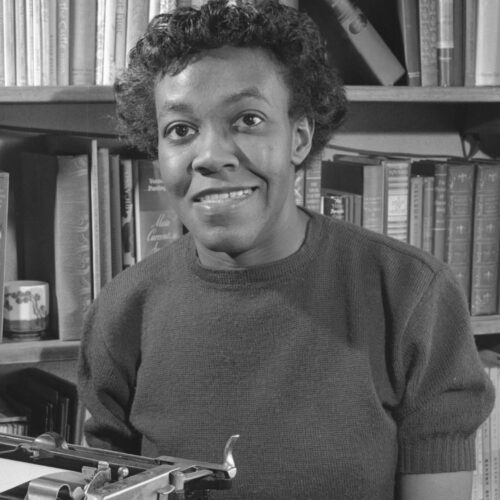
Gwendolyn Brooks was born on June 7, 1917, in Topeka, Kansas. She grew up with her family in Chicago. Both of her parents encouraged her love of reading and writing. Her father would entertain Brooks and her brother through song, spoken poetry, and stories about his father who had escaped slavery. Her mother nurtured Brooks’ creativity and played the piano. Her mother supported her creativity by encouraging her to share her work. She did so by writing plays for church events. She became a published poet at just thirteen with “Eventide” in American Childhood. She continued writing in her adolescence and was frequently published in the Chicago Defender, the most prominent Black newspaper of the first half of the 20th century.
Early Career
Brooks became involved with the National Association for the Advancement of Colored People’s (NAACP) Youth Council while in college. This surrounded her with like-minded individuals and fostered her devotion to creativity and activism. She also met her husband, Henry Blakely Jr., a fellow poet in the Youth Council. The couple raised two children. Their life together inspired her writing. They found a community of fellow poets in their Brownsville neighborhood. Brooks gained momentum and enhanced her skills through writing workshops at the South Side Community Art Center. Brooks released her first poetry collection, A Street in Bronzeville in 1945. Her poems paint a vivid portrait of life for a young African American girl growing up in Chicago.
Increased Political Focus
Brooks’ work became increasingly politically focused. She explored themes of race and justice more directly. This shift happened after she attended the Black Writers’ Conference at Fisk University. She was inspired by the other writers who explored and represented Black culture in their work. Brooks’ third poetry collection, titled The Bean Eaters, embraces a more raw and direct tone. One of the collection’s most notable works, “We Real Cool,” critiques the disenfranchisement of Black men in the United States. This poem acts is a tribute and a form of protest. Brooks’ commitment to investing in her community led her to Black publishers such as Broadside Press and Third World Press.
Religion & Spiritual Literary Themes
Brooks’ daughter, Nora, recounts that her mother did not strictly adhere to an organized religion. Nora recounts, “Faith was important to her, but religion was not.” She held that her service to others was a spiritual practice. Brooks demonstrated this in assisting others in buying groceries, paying their rent, or even kind notes. Brooks’ veto with modern religion is shown in her poem, “God Works in a Mysterious Way.” She reflected on how modern religion had become materialistic.
Other religious themes can be found in her poetry as well. Her poem “The Womanhood” references hell, heaven, Sunday school, and God. The poem says that storytelling, love, and God not only help us survive life, but are what make life meaningful. Those close to Brooks could see how she lived her spiritual beliefs. Haki Madhubuti, who is a longtime friend and fellow poet, described Brooks’ religion as kindness.
Teaching Career
Brooks began teaching in higher education during the 1960s. She taught creative writing, poetry, and fiction at various colleges and universities. Brooks was known for her dynamic teaching.
Gwendolyn Brooks was a highly regarded 20th-century American poet. Her career was widely celebrated during her lifetime. Not only did she publish over twenty books and win a Pulitzer Prize, but she also became the first Black woman appointed as Poet Laureate Consultant in Poetry. She served as Illinois’ poet laureate for thirty-two years. Brooks’ work continues to inspire writers and activists alike. She died on December 3, 2000. Her boundless legacy continues to influence generations of writers.