Biography
Early Life
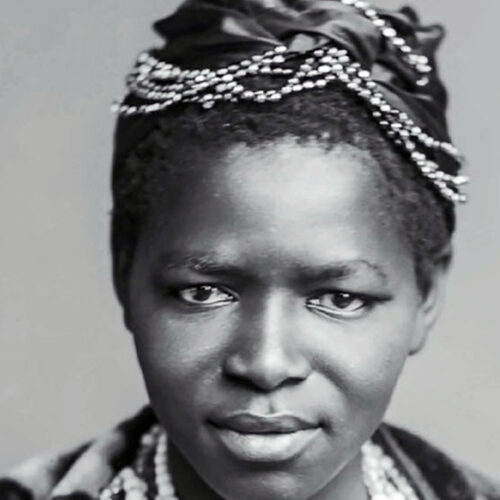
Charlotte Manye was born on April 7, 1871, in Fort Beaufort, South Africa. Her mother was a teacher and her father a Presbyterian lay preacher. She attended missionary schools for both primary and secondary education. Her family moved to Kimberly, South Africa as soon as she finished her education. She got a job there teaching indigenous languages to foreigners and basic English to African workers. She also began singing in the African Jubilee Choir with her sister, Katie. The girls were given an opportunity to go on a two-year tour throughout England with the choir. The choir was re-signed for two additional tours in Canada and America.
It was during the American leg of the tour that she met Bishop Derrick, a minister of the African Methodist Episcopal Church AMEC). She was able to gain a scholarship and opportunity to study at Wilberforce University in Ohio. She earned her Bachelor’s in Science in 1903. This made her the first South African woman to earn a university degree from an American university. Manye moved back to South Africa right after graduation to begin missionary work for the AMEC. She married her husband, Maxwell Maxeke, who also attended Wilberforce University.
Religious Faith & Activism
One of Maxeke’s most notable achievements is the opening of the Wilberforce Institute in South Africa in 1908. This institution is now known as Wilberforce Community College. The college was established as a place that could foster education, inclusivity, and faith for African students. These beliefs are still prioritized today because of the strong foundation that Maxeke set. Another one of her greatest achievements was working for the anti-pass movements of South Africa.
During the 1910s in South Africa under apartheid (African segregation), Black Africans were required to carry a form of identification document called a “pass.” Urban areas were considered to be strictly white, so Africans looking to go into those regions would have to get their passes verified by their white employers to enter that specific area. If the Africans in the region did not have a verified pass, they were subjected to punishment and imprisonment under the law. This inequality caused an uproar in South Africa. Maxeke was a driving force. She founded the Bantu Women’s League, which is now part of the African National Congress Women’s League. This organization was created to fight against the pass laws for nonwhite women. The organization was founded in 1912. The pass requirement was finally dropped in 1918.
Maxeke was also one of the first female members of the South African Native National Congress. The South African Native National Congress was formed to fight for non-white South African voting rights and the elimination of apartheid. She was heavily involved in protests in the Witwatersrand Province of South Africa about low wages and participated in the formation of the Industrial and Commercial Workers’ Union (ICU) in 1920. Charlotte Maxeke has been named the “Mother of Black Freedom” for the work she did for black women and South African rights and for her constant fight for freedom and peace. She was active in AMEC serving as a delegate. She died in 1939 leaving behind a legacy of servant leadership.