Biography
Early Life
Gertrude Morgan was born on April 7, 1900, in LaFayette, Alabama. She was the seventh child of Frances and Edward Williams. She showed an interest in art from an early age. When she was 10, the family moved to Columbus, Georgia. She left school before finishing third grade but later developed her reading and writing skills after joining Rise Hill Baptist Church. She studied scripture and read texts that would go on to shape her artwork.
Morgan worked as a domestic servant and married her childhood boyfriend, Will Morgan, in 1928. He also worked in domestic service. In 1934, she had her first spiritual experience, saying that God told her to take up her cross and follow him. Four years later, she and her husband left Columbus and returned to Alabama. She worked as a nursemaid and nanny and continued her healing work. After about five years, she felt God was calling her to find a new way to share the Gospel. That calling led her to move to New Orleans, Louisiana.
Religious Activism
Shortly after arriving in New Orleans, Morgan met Sister Cora Williams and Mother Margaret, who were part of the Holiness and Sanctified movement, a tradition that expressed faith through music and dance. The three women preached together on the streets of New Orleans. They opened an orphanage and chapel to serve children in need in their neighborhood.
Morgan worked alongside them until 1957, when she had another spiritual experience. She said God told her to become the bride of Christ. In response, she began wearing only white and moved to the French Quarter, the heart of New Orleans known for its music, street life, and deep cultural roots. Inspired by that environment, she danced through the streets, sang loudly, and preached using a tambourine and a homemade megaphone.
Morgan also started the Everlasting Gospel Mission in New Orleans. She used the front lawn of her home to display signs and paintings along the sidewalk. The Mission welcomed both believers and non-believers. She kept doing what she had always done — dancing, singing, preaching, and painting. For more than 20 years, she led worship in a white room she called the Prayer Room, where she performed musical readings of the Bible on a regular basis.
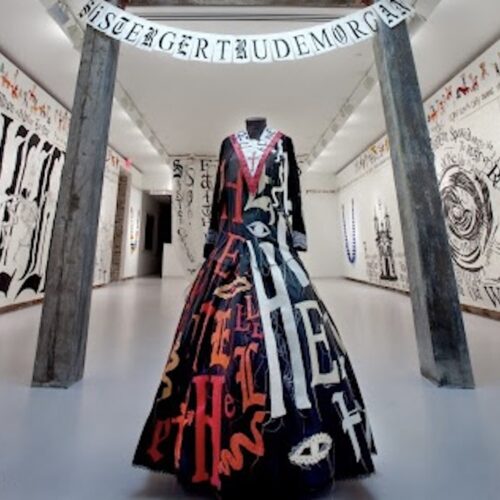
Morgan painted her spiritual visions on many different surfaces, including windows, Styrofoam, plastic, wood, and cardboard, using pen, watercolor, acrylic paint, and crayon. She painted almost entirely from the Book of Revelation in the Bible.
Her work was featured in three major art exhibitions in the 1970s: Dimensions of Black at the La Jolla Museum of Art in California, Symbols and Images: Contemporary Primitive Artists, and Twentieth-Century Folk Art at the Museum of American Folk Art, now called the American Folk Art Museum. Five years later, Morgan decided to stop painting. She said God was not pleased with the fame and attention her art was bringing her. She felt called to write poetry instead and spent the rest of her life writing and preaching.