Biography
Early Life
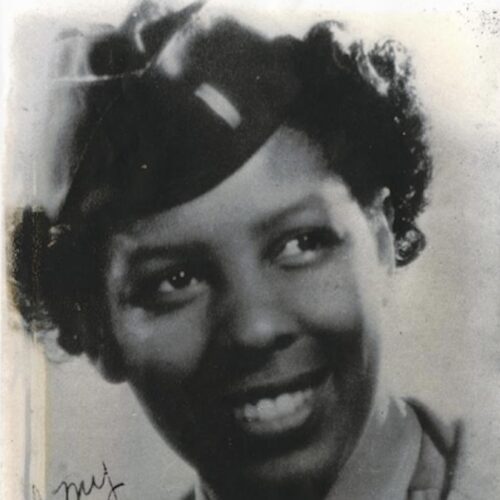
Fannie Griffin McClendon was born on September 22, 1920, in Lafayette, Louisiana. She was raised by her mother with her younger sister Effie. Her mother worked as a housekeeper to support the family. She began attending Holy Family Catholic School at six years old. Her mother eventually moved them to Camden, New Jersey. The family lived in a YWCA until Fannie reached high school. They later moved to Harlem, New York, where she went to the integrated high school, Wadleigh.
Military Service
McClendon enlisted in the Army when she was 19 years old. She served as an officer in the Women’s Army Corps and the United States Women’s Army Auxiliary Corps (WAC) from 1942 to 1945 or 1946.
She is best known for her service in the 6888th Central Postal Directory Battalion, also called the Six Triple Eight. She was one of 855 Women’s Army Corps members in this unit. It was a segregated battalion and the first and only all-Black female company to serve overseas during World War II.
The battalion came about through years of pressure from civil rights groups like the NAACP and the National Council of Negro Women. They pushed the United States War Department to allow Black WAC members to serve abroad.
McClendon faced discrimination based on both her race and her gender throughout her service. The WAC was segregated. Black women lived in separate spaces, used different water fountains, ate in separate dining areas, and were kept out of white officers’ clubs.
The battalion was deployed to Europe in 1945 after serving stateside. Their assignments included Birmingham, England, and Rouen, France. Their job was to sort and route millions of letters and packages to American servicemen and civilians, helping to keep morale up during the war. They worked seven days a week in eight-hour shifts. The women cleared roughly two to three years’ worth of backed-up mail in under three months.
McClendon served from 1942 to 1945 and again from 1950 to 1971. She served during World War II, the Korean War, and the Vietnam War. She returned to active duty in the China Burma Theater and was promoted to lieutenant in 1948. That same year, President Harry S. Truman signed Executive Order 9981. This ended segregation in the military. Over the course of her career, McClendon traveled widely, including to the United Kingdom, Scotland, Germany, France, Spain, and Panama. In a 2019 interview, she reflected on her service: “I think it’s wonderful that we’re in a period when women can choose to do the things that they’re doing.”
She met her husband, Mac McClendon, on a military base in Cheyenne, Wyoming. He served in the National Guard and later the Air Force. They married in 1959 and were transferred to Zaragoza Air Base together in Spain in 1960. He served as a captain in Tactical Air Command, and she served as a major in Strategic Air Command.
Religious Influence
McClendon was a practicing Catholic throughout her life. When asked about her heroes, she named her mother and the Catholic nuns who shaped her early years. She also spoke warmly of her priest. She described him as one of the finest people she had ever known.
Awards and Recognition
McClendon had twenty-six and a half years of military experience. She worked in supply for the Women’s Air Force as a Squadron Commander before retiring in 1971.
President Joe Biden signed legislation awarding the 855 members of the 6888th Central Postal Directory Battalion the Congressional Gold Medal on March 14, 2022. At the ceremony, he called the soldiers trailblazers and promised they would not be forgotten. The battalion was honored with a monument at the Buffalo Soldier Commemorative Area at Fort Leavenworth, Kansas, in 2018. The names of 500 battalion members are displayed alongside a 25-inch bust of their former commander, Lt. Col. Charity Adams Earley.
McClendon received a Living Legend Award from the Department of Veterans Services in 2020.