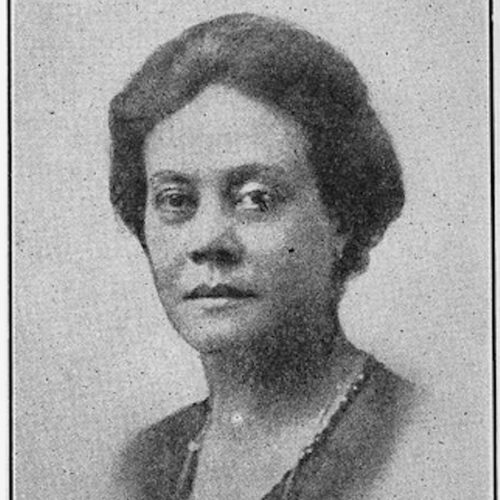
Biography
Early Life
Alice Moore was born in New Orleans, Louisiana, on July 19, 1875. Her parents were Patricia Wright and Joseph Moore. Not much is known about her father. He was not present for most of her childhood. Her mother was a former slave who received her freedom two years after the Emancipation Proclamation (1865). She raised Alice and her older sister Mary alone. Moore excelled in her studies in spite of the facing financial hardship and family strife. She graduated from high school at 14 years old. She received her undergraduate degree at 17 years old from Straight University (now Dillard University).
Moore taught for four years after she graduated at Marigny Elementary School in New Orleans. She published her first book of poetry and short stories about love and loss in Violets and Other Tales. Moore, her sister, and her mother moved to Massachusetts after she finished teaching at the elementary school. This allowed Moore to pursue her dream of writing. She was able to get a job writing for The Woman’s Era newspaper. This newspaper was published for Black women by Black women. Moore moved to New York City in 1897. She ran the education program for White Rose Mission Settlement. This was a Christian social center for Black women who had just moved to the North looking for work.
Love and Poetry
Moore began to exchanging letters with the Harlem Renaissance poet Paul Laurence Dunbar while she was in New York City. They married in 1898 and moved to Washington D. C. It was during this marriage that Alice wrote her most popular work, The Goodness of St. Rocque and Other Stories. Her marriage was not a very pleasant experience. Moore used it as a source of inspiration for her future works. Her husband was physically and sexually abusive during their four-year marriage. The couple finally split in 1902 after a violent episode that sent her to the hospital. Moore moved to Delaware and began to work for Howard High School. She taught English and served as head of the department from 1910 to 1920. She took a leave of absence in 1907 to study literature, psychology, and education at Cornell University. She married fellow teacher Henry Arthur Callis in 1910. Moore also had a long-term, intimate relationship with the principal of Howard High School, Edwina Kruse. The women exchanged letters between 1907 and 1911. They wrote about everyday affairs and their affection for one another. Her marriage to Callis ended in 1911. Moore married her third and final husband, Robert Nelson, in 1916.
Religious Faith and Activism
Dunbar-Nelson was very involved in racial equality and women’s rights movements. She focused on Louisiana Creole history and culture in her poetry and writing. She paid special attention to class and gender divisions. One of her important contributions to social activism was her role in the Middle Atlantic States campaign for women’s suffrage. She was the sole field organizer for events and rallies. She also served on the Women’s Committee of the Council of National Defense. This committee’s primary goal was to organize women’s wartime labor during World War I. Dunbar-Nelson used her gift of writing to showcase the sacrifice of Black soldiers for their country, even though they faced discrimination. She started the Wilmington Advocate newspaper with her husband, Nelson. Each edition was used to spark racial uplift and promote the fight for equality. Dunbar-Nelson often focused on anti-lynching movements and fought for social justice. She also wrote for the A.M.E. Review, the official journal for the African Methodist Episcopal Church.
Dunbar-Nelson served as Executive Secretary for the American Friends Interracial Peace Committee during the last decade of her life. This Quaker committee tried to get African Americans to join peace organizations. Dunbar-Nelson became the first Black woman to serve on the Delaware State Republican Committee in 1920. She helped defeat a sitting United States Senator from Delaware, Caleb Layton. He refused to vote for the Dyer Anti-Lynching Bill in 1922. Among her legacy highlights, Dunbar-Nelson organized a voter registration drive that added 12,000 new voters to the polls.