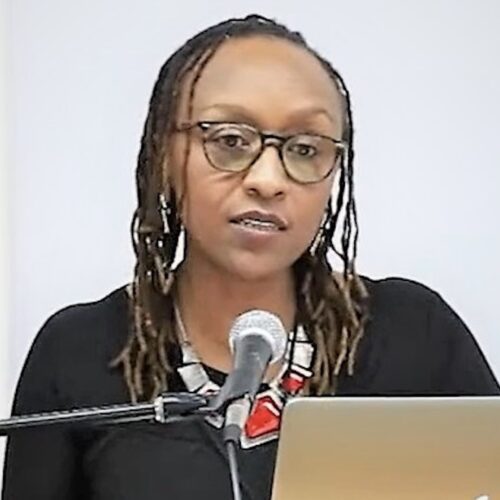
Biography
Early Life
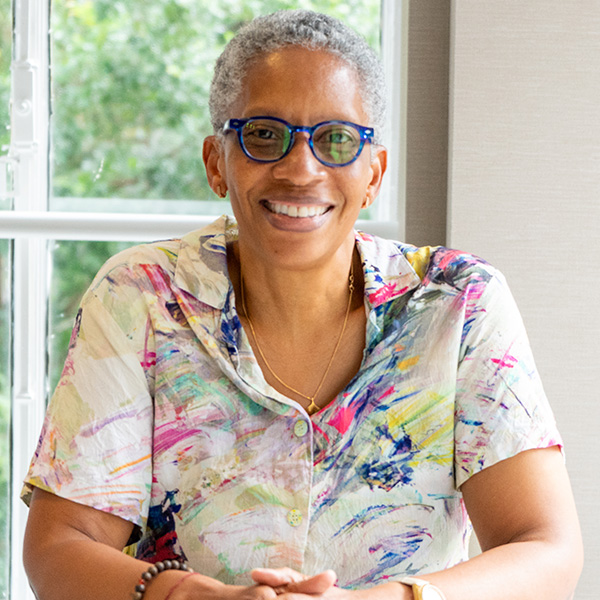
Elizabeth Mburu was born in 1968 in Nairobi, Kenya, and grew up with five brothers and sisters. Faith was part of her family long before she was born. Her grandfather helped translate the Bible into Kikuyu, the language of her people in Central Kenya, back in the early 1900s. Her grandparents were Christians, her parents were Christians, and she grew up in that same faith.
Even so, she made her own personal decision to follow Christ in 1993. In the late 1990s, she started working with street children in Nairobi. That experience stayed with her. She saw how much people in her community were struggling, and she came to believe that good, solid Bible teaching could help bring real change. That belief pushed her toward school.
She earned her first degree in Kenya at a school now called International Leadership University. Then she traveled to the United States to keep studying, first at a school now known as Corban University School of Ministry. She later earned her PhD from Southeastern Baptist Theological Seminary. In 2008, she became the first woman ever to earn that degree from that school. In most of her classes, she was the only woman. She finished anyway.
Religious Faith & Activism
For Mburu, faith is not something you just study in a classroom. She wants people to truly understand the Bible and know how to apply it to their own lives and cultures. That desire has driven everything she has done.
She taught in the United States before moving back to Kenya. There she became a professor, teaching about the New Testament and the Greek language. She teaches at several universities in Kenya and South Africa. She also serves as Africa Regional Coordinator for Langham Literature, a group that publishes books and resources for Christian leaders across Africa.
One of her strongest beliefs is that the Bible should connect with the culture of the people reading it. She helped update the Africa Bible Commentary, working as an editor for the New Testament section. In 2019, she published her own book called African Hermeneutics. Hermeneutics means the study of how to read and understand the Bible. Her book offers a way of reading Scripture that speaks to African life and culture without changing what the Bible actually says.
She also knows that translating the Bible is serious, careful work. It is not simply replacing words in one language with words in another. It takes deep study of the original Greek and Aramaic languages, along with a clear understanding of the history and culture of Bible times. The goal is always to understand what the author meant, without mixing in personal opinions.
Mburu writes for Christian journals and helps publish books by African writers. She belongs to several organizations working to strengthen Bible education across Africa. She also speaks honestly about problems she sees in African churches today, including teachings that promise wealth to believers, the mixing of Christian faith with outside belief systems, and poor Bible interpretation. She works to provide something better — teaching that is true to Scripture and meaningful to African readers.
Elizabeth Mburu is married to Caxton Mburu. They have three adult children. Through her teaching, writing, and leadership, she continues to shape Christian education across Africa, preparing the next generation of pastors, teachers, and leaders.