Biography
Early Life
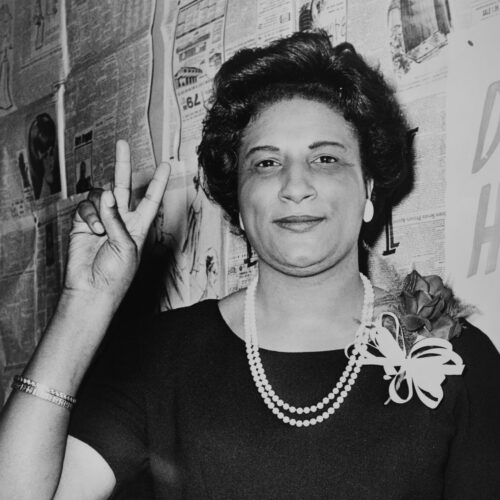
Constance Baker Motley was born on September 14, 1921, in New Haven, Connecticut. She was the ninth of twelve children in a family of Caribbean immigrants from the island of Nevis. Her parents, Rachel Huggins and McCullough Alva Baker, came to the United States in search of better opportunities. Before immigrating, Rachel worked as a seamstress and teacher, while McCullough was a cobbler. In America, Rachel became a domestic worker, and McCullough worked as a chef for various Yale University student societies, including the prestigious Skull and Bones club. Despite their limited formal education, which Motley described as equivalent to the tenth grade in the United States, her parents placed a strong emphasis on community involvement and education. Her mother was a dedicated activist who founded the New Haven chapter of the NAACP. This instilled in Motley a passion for civil rights from an early age.
Despite her strong academic abilities, Motley could not afford to attend college after high school. Her determination and intelligence caught the attention of Clarence Blakeslee, a wealthy white contractor and philanthropist. He was so impressed by her that he agreed to fund her education. With his support, Motley graduated from New York University in 1943. She went on to earn a law degree from Columbia University in 1946.
Motley took a major step toward achieving her dreams before she graduated from Columbia Law School in 1946. She joined the NAACP Legal Defense and Educational Fund while still in law school. She worked alongside Thurgood Marshall, the future Supreme Court Justice, and Robert L. Carter, who would later serve as a federal judge. As the fund’s first female attorney, she played a crucial role in the legal battles that dismantled segregation. Her legal career was marked by groundbreaking achievements. She wrote the original complaint for Brown v. Board of Education, the landmark case that ended legal segregation in public schools. She argued and won nine civil rights cases before the U.S. Supreme Court. One of her most notable victories was securing James Meredith’s right to enroll at the University of Mississippi in 1962. Motley’s early life and education laid the foundation for her lifelong commitment to justice, equality, and the fight for civil rights.
Religious Faith & Activism
Motley was a lifelong member of the Episcopal Church. Her faith guided her commitment to justice and equality. She attended St. Luke’s Episcopal Church, where she later married her husband, Joel Motley Jr., in 1946. Her religious beliefs influenced her deep sense of responsibility to fight for civil rights and uplift marginalized communities throughout her life. She remained an active member of the church and upheld its values of service and social justice in both her legal and political careers. Her faith and belief in equality drove her to defend activists such as Martin Luther King Jr., the Freedom Riders, and the Birmingham Children’s Marchers, even visiting King while he was imprisoned.
Beyond her legal work, Motley carried her fight for justice into public service. In 1964, she became the first Black woman elected to the New York State Senate. She advocated for housing rights for low-income Black and Latino communities. She made history again as the first woman to serve as Manhattan Borough President. She developed plans to revitalize inner-city schools and housing. Her rise continued in 1966 when President Lyndon B. Johnson appointed her as the first Black female federal judge in U.S. history. Despite opposition from Southern senators due to her civil rights work, she was confirmed and later became Chief Judge of the U.S. District Court for the Southern District of New York in 1982.
Constance Baker Motley and her husband lived in Harlem, New York City. They maintained a second home in Chester, Connecticut, from 1965 until 2005. They were married for 59 years until Motley’s death from congestive heart failure on September 28, 2005. Her funeral was held at the same Connecticut church where she had been married. A public memorial service was later held at Riverside Church in Manhattan. She was survived by her son, Joel Wilson Motley III, who became co-chairman of Human Rights Watch, and three grandchildren.