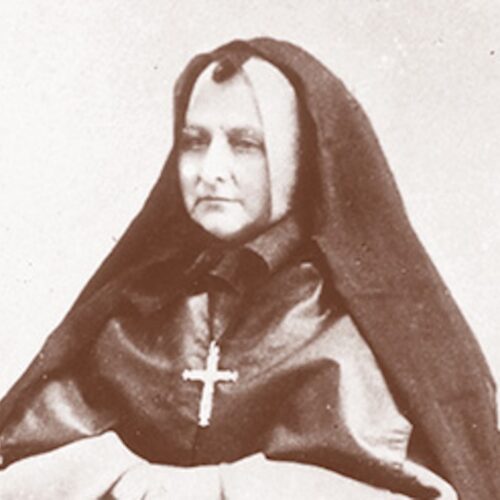
Biography
Early Life
Theresa Maxis Duchemin was born in 1810 in Baltimore, Maryland. Her parents were not married. Her father, Arthur Howard, was a white British military officer. Her mother was Betsy Maxis, a mixed-race woman from Haiti who had fled to America.
The Duchemin family adopted her when she was young. They taught her to speak French and Latin. She avoided some of the racism that other Black people faced at that time because she looked white.
Duchemin went to a Catholic boarding school. She got an excellent education there. This was unusual for women in the 1800s. She decided to become a religious leader and teacher after she graduated.
Religious Faith & Activism
At age 19, Duchemin helped start something amazing when she was 19 years old. She joined with three other women to create the Oblates of Providence in Baltimore in 1829. This was the very first group of Catholic nuns made up Black women in America. With the aid of Father James Hector Nicholas Joubert, SS Theresa Maxis Duchemin, Elizabeth Lange, Marie Magdalen Balas, and Rose Boegue founded a convent and Catholic school for girls.
The women founded both a convent and a school for girls. Duchemin became known as Mother Maxis or Mother Theresa. She served as the leader of the group. Being a woman of color in the Catholic Church was very hard. The church was run by white men who often treated women and people of color poorly. White mobs sometimes attacked the sisters. This made it difficult to find students for their school.
Two Belgian priests came to Baltimore in 1843. Father Louis Florent Gillet asked Duchemin to help him start a new religious group and school in Michigan. She left Baltimore and moved to Monroe, Michigan in 1845. There, she and Father Gillet started the Sisters of Providence. This convent became known as the Servants of the Immaculate Heart of Mary. They also opened St. Mary’s school.
Challenges & Exile
Duchemin faced many problems as a leader. The Bishop of Detroit removed her from her leadership position in 1859. This happened because two bishops were fighting over who had control of her religious group. The bishop sent her to work in Pennsylvania instead.
Duchemin was a strong woman who spoke up for what she believed in. She asked to expand the Pennsylvania mission. The bishop told her no. She openly disagreed with the bishop’s decision. She faced racist threats and attacks because she was a woman of color challenging white male authority.
Duchemin chose to go into exile. She felt that she was causing problems for her religious sisters. She lived and worked with the Grey Nuns in Ottawa, Canada for 18 years. She hoped this would help reunite the different groups of sisters.
Duchemin made many requests to return to her congregation in West Chester, Pennsylvania. She was finally allowed to do so in 1885. She spent her last seven years with the religious community she had helped create. She died on January 14, 1892.
The school that Duchemin helped found still operates today. It remains one of the oldest schools for Black Catholic children in the United States.