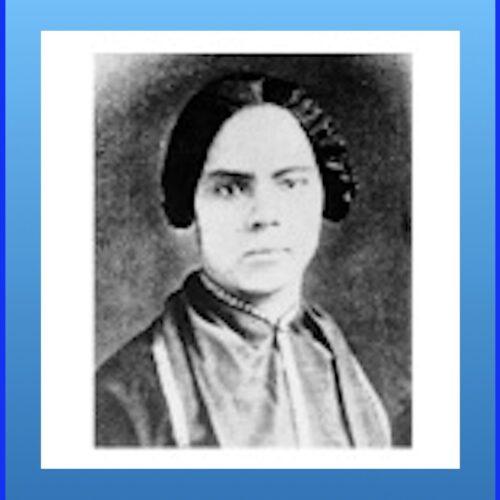
Biography
Early Life
Mary Ann Shadd Cary was born in 1823 in Wilmington, Delaware. Her parents were free African Americans, even though Delaware was a slave state. Her father, Abraham D. Shadd, was a shoemaker. He also wrote for The Liberator, a newspaper that fought against slavery. Her mother was Harriet Parnell Shadd. Cary was the oldest of thirteen children.
Her parents cared deeply about ending slavery. Her family moved to Pennsylvania when Delaware made it illegal to teach African American children. There, Cary went to a Quaker high school in Westchester. Her family also helped with the Underground Railroad. This was the network that helped enslaved people escape from the South to freedom in the North.
Cary became a teacher after finishing school. She opened schools for African American children in several places. She taught in Wilmington, West Chester, New York, and New Jersey. She even opened a school in Canada that welcomed both Black and white students to study together.
Congress passed the Fugitive Slave Act in 1850. This law made it very dangerous to help escaped slaves. The law said that people who had escaped to free states could be captured and forced back into slavery. Even free African Americans could be captured and sold into slavery. Cary felt she was no longer safe living in the United States.
Britain had made slavery illegal in all its North American territories in 1833. This included the areas that would later become Canada. Many Black Americans moved there seeking freedom and safety.
Cary decided to move to Windsor, Canada, with her brother Isaac. There, she married Thomas J. Carey and had two children with him. She opened her integrated school and continued her work as a teacher.
Advocacy as a Newspaper Editor
Cary started something amazing in Canada. She founded a newspaper called The Provincial Freeman in 1853. This made her the first Black woman newspaper editor in North America. Her newspaper was also Canada’s first newspaper that fought against slavery.
The newspaper ran from 1853 to 1860. It promoted several important ideas. It wanted Black people to integrate into Canadian society. It supported the complete end of slavery. It also encouraged African Americans to be self-reliant and start businesses. The newspaper was more critical of white America than most other African American newspapers of the time.
Cary’s husband died in 1860. The next year, the Civil War began in the United States. She returned to America to help the Union Army. She recruited soldiers to fight for the North.
Cary made history again when she returned to Washington, D.C. She became the first woman to attend Howard University Law School. She took classes at night and taught children during the day. She graduated with a law degree in 1870. She was the second Black woman and one of the first women of any race to earn a law degree in America.
Advocacy as a Lawyer
Cary practiced law for the next ten years. She also continued writing and giving speeches. She wrote for The New National Era, an African American newspaper. She became the first woman allowed to speak at African American conventions.
Cary helped start the Colored Women’s Progressive Franchise Association. She also joined the National Woman Suffrage Association and spoke at their 1878 convention. She testified before Congress about the Fourteenth and Fifteenth Amendments. While she supported voting rights for Black men, she criticized the Fifteenth Amendment because it did not give women the right to vote.
Mary Ann Shadd Cary is remembered as a pioneer. In 2023, UNESCO added her papers to their important world documents collection. Her home in Washington, D.C. is now a National Historic Landmark.