Biography
Early Life
Leontine Turpeau Current Kelly was born in 1920 in Washington, D.C. Both of her parents were ministers. Her father, Rev. David DeWitt Turpeau, served as pastor of Mt. Zion Methodist Episcopal Church. Her mother, Ila Marshall Turpeau, was also a minister and an active member of the NAACP. Leontine’s parents taught her to stand up for justice and equality from a young age.
Her family moved to Pittsburgh. Her father served four terms in the Ohio State Legislature. Kelly grew up with seven brothers and sisters. She grew up in a house that the church owned. Her home was always full of discussion about faith and social change. One amazing discovery in their family’s basement was a hidden room that was once part of the Underground Railroad. This discovery helped her understand the struggle for freedom. She was also inspired by educator and civil rights leader Mary McLeod Bethune. Bethune became her mentor.
Education and Pastoring
Kelly began college at West Virginia State College. She left after three years to marry Gloster Bryant Current in 1941. They had three children before divorcing in the early 1950s. In 1956, she married a Methodist minister named James David Kelly. He died suddenly in 1969. The members of Galilee Church asked Kelly to become their pastor.
She graduated with honors from Virginia Union University in 1960. Kelly worked as a social studies teacher. She also became a lay leader in the Methodist Church. She was ordained as a deacon in 1972 and as an elder in 1977. She earned her first Master of Divinity degree from Wesley Theological Seminary. She earned a second one from Union Theological Seminary.
Religious Leadership and Advocacy
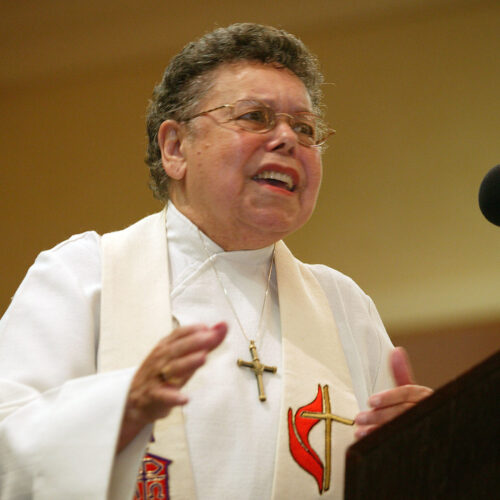
Kelly earned her doctoral degree at Garrett Evangelical Seminary in 1984. She made history that same year. Kelly became the first African American woman elected bishop in a major U.S. religious denomination. The United Methodist Church’s California-Nevada Conference chose her to lead more than 100,000 members. She was active in the United Methodist Clergywomen’s movement to remove barriers to women in ministry.
Bishop Kelly broke many barriers. She was the first woman to preach on the National Radio Pulpit of the National Council of Churches. She served as Assistant General Secretary of the church’s Evangelical Unit. In 1985, she was arrested during a Good Friday protest at a weapons lab. Kelly was the only woman bishop to do so. She was the first African American woman bishop to address the international World Methodist Council in Nairobi, and was also instrumental in founding Africa University in Zimbabwe.
Bishop Kelly’s commitment to ministry continued long after her retirement in 1988. She remained active by teaching at seminaries, leading healthcare and AIDS ministries, and serving as a powerful advocate for LGBTQ+ inclusion within the church.
Her tireless work earned her numerous honors, including ten honorary degrees and many prestigious awards. Among these honors was the Southern Christian Leadership Conference’s (SCLC) Grassroots Leadership Award in 1982. She also received the Martin Luther King Jr. Drum Major for Justice Award, presented by the SCLC-Women’s Organizational Movement for Equality Now in 1987. She was formally remembered for her historic legacy when she was inducted into the National Women’s Hall of Fame in 2000.
Bishop Leontine T. C. Kelly’s life stands as a powerful witness to faith, courage, and justice. Her legacy continues to light the path for women and people of color in church leadership today.