Biography
Early Life
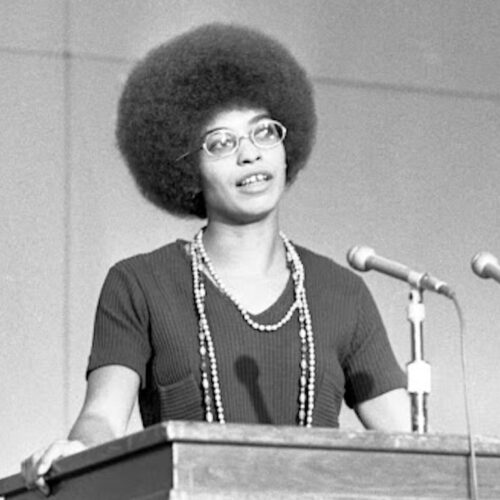
Angela Davis was born January 26, 1944 in Birmingham, Alabama. She was christened in the Episcopal Church. She belonged to her church youth group and attended Sunday School. She was a member of the Girl Scouts. Her troupe picketed in Birmingham to protest racial segregation when she was 15 years old. It was one of the most racially segregated cities in the country.
Her neighborhood was called “Dynamite Hill.” It was named so because the KKK (Ku Klux Klan) repeatedly bombed the homes of Black people. Birmingham was dangerous. This did not prevent Davis’ mother, Sallye Davis, from speaking out about racism. She was involved in Communist-based Black civil rights organizations.
Davis attended Parker High School in Birmingham. The Quaker American Friends Service Committee connected her with an integrated Northern high school. In 1959, she was given a scholarship to the forward-thinking private Elizabeth Irwin High School in New York City.
Davis received a full scholarship to Brandeis University in Massachusetts in 1961. She studied French Literature. She studied at the Sorbonne in Paris. She studied under the renowned philosopher Herbert Marcuse at Brandeis. His critical theory and Marxist lectures influenced her. Davis earned a Magna Cum Laude Bachelor’s degree in 1965. She earned a master’s degree from the University of California, San Diego in. She did more graduate studies in Critical Philosophy and Marxist Theory at the University of Frankfurt in Germany. Davis earned a Ph.D. in Philosophy from Humboldt University in East Berlin.
Davis joined the Black Panther Party in early 1968. She also joined the Communist Party USA’s all-Black Che-Lumumba Club that same year.
Davis was hired by the University of California, Los Angeles (UCLA) in 1969. She was an Assistant Professor of Philosophy. Governor Ronald Reagan pressured the University of California Board of Regents to dismiss her. The University dismissed her because of her ties to the Communist Party.
Davis bought a gun that was used in a disastrous attempt to free Soledad Brother George Jackson in 1970. The Soledad Brothers were charged with murdering a prison guard at Soledad Prison, and she believed that they had been framed because of their political beliefs. During their trial, there was a shootout in court leading to multiple deaths. Davis went into hiding. Her arrest and trial spurred a worldwide “Free Angela” movement. The Presbyterian Church donated $10,000 to the Davis Defense Fund. She spent 18 months in jail. An all-white jury found Davis not guilty of any charges in 1972.
Davis taught at Rutgers University and San Francisco State University in 1970. By 1991, she had become the Distinguished Professor Emerita in Feminist Studies and the History of Consciousness at the University of California, Santa Cruz. She has made major contributions to feminism, critical theory, and prison abolitionism. Some of her books have become standard texts in these fields. These include Are Prisons Obsolete? and Women, Race, & Class.
Davis founded Critical Resistance, a movement to abolish the prison-industrial complex. She also founded the National Alliance Against Racist and Political Repression in 1973. This was to help free political prisoners. Davis was the Communist Party’s candidate for U.S. vice president in 1980 and 1984.
Activism That Later Informed and Inspired Womanism
Davis taught at the Humanist Institute. It partners with Unitarian Universalists, Jewish humanists, Greenpeace, and others. She is currently a part of the American Humanist Association’s Center for Education.
She came out as a lesbian in 1997. Black secular women like Alice Walker and Angela Davis described how race, class, and gender oppressions affected Black women. This challenged white religious culture and the Black church. Early Womanist theologians built upon their insights.
Black non-religious clubwomen knew the influence that churches had on women’s lives. They understood that churches helped form women’s visions of an antiracist common good. Black churchwomen’s organizations supported activism that was often assumed to be only non-religious.
Angela Davis believed that true Christians would fight all forms of injustice. She saw how faith inspired her people in their struggle for freedom, even though she was not a Christian. Black Christians and activists like Davis shared similar visions for a just future. Radical Black feminists such as Davis and Alice Walker were tied to religious scholars. These scholars practiced radical Black feminism in the development of their theology. They were connected by a shared spirituality based on spiritual practices of love and freedom.