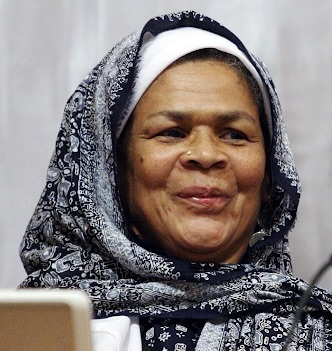
Biography
Early Life
Amina Wadud was born in 1952 in Bethesda, Maryland. Her birth name was Mary Theasley. She was raised in a Methodist home. Her father was a Methodist minister. He shaped her early faith and sense of justice. She and her father attended the March on Washington in 1963. This is where Dr. Martin Luther King Jr. gave his famous “I Have a Dream” speech. That moment showed her how religion and justice could work together.
Wadud began to ask big questions about God even when she was a child. She explored different branches of Christianity and compared their beliefs. She lived with families of other faiths when she was in high school. These families included Jewish and Unitarian Universalist believers. These experiences helped her value different ways of thinking about faith.
Wadud converted to Islam while studying at the University of Pennsylvania in 1972. She also changed her name to Amina Wadud. This decision shaped the direction of her life. She became interested in how Islam could support women’s rights.
Religion & Activism for Women
Wadud became known as a leader in Islamic feminism. From 1989 to 1992, she taught at the International Islamic University in Malaysia. While there, she studied the role of women in the Quran, Islam’s holy book.
During this time, she wrote a groundbreaking book called Qur’an and Woman: Rereading the Sacred Text from a Woman’s Perspective. In it, she reexamined verses about women in the Quran. She argued that Islam teaches justice and equality for everyone, regardless of gender.
In 2005, Wadud made international headlines when she led a mixed-gender prayer service in New York City. This was rare and controversial because only men usually lead prayer in Islam. Before the service, Muslim activist Asra Nomani said, “The voices of women have been silenced by centuries of man-made traditions.” The service caused debate across the Muslim world. Some supported Wadud; others strongly disagreed. But her action sparked new conversations about the role of women in Islam.
Wadud didn’t stop with writing and teaching. She also pushed for women’s rights in Muslim-majority countries. She spoke out for both legal reform and social change. Her work has inspired many to rethink male-centered traditions and push for fairness in religious life.In 2006, she published Inside the Gender Jihad: Women’s Reform in Islam. As a Black Muslim woman, Wadud brings a special point of view. She talks about gender, race, and justice—all at the same time.
Wadud has stayed committed to her mission even when facing strong criticism. She helped open doors for younger Muslim women to speak out. She published her spiritual memoir, Once in a Lifetime, in 2022. In it she offered a fresh take on Islam’s Five Pillars.
Amina Wadud remains a powerful symbol of courage and faith. She helps people see how Islam can support gender justice and equality through her scholarship and activism.